

 Home
HomeThere is a moment every engineering manager remembers from the last two years. A developer opens GitHub Copilot for the first time, types a comment describing what a function should do, and watches the tool draft the entire implementation in three seconds. It is correct. It handles the edge cases. It is cleaner than what the developer would have written in twenty minutes. The developer stares at the screen, then looks up and asks a question nobody had a clean answer to yet: so what exactly is my job now?
That question is not an existential crisis. It is an invitation to a better job. But only if the answer is given honestly — and only if the employer does the redesign, rather than reading the moment as a cost-cutting opportunity and stopping there.
The accurate version: typing got cheap, and the scarcest thing in an engineering function is now the human who can design the system, hold the architectural integrity together, and decide what gets built at all. The engineers who flourish will be architects. The ones who only typed will feel the pinch. In Singapore, where technology talent is expensive, regulatory expectations on software quality are rising, and the tripartite system was built precisely to manage transitions like this one, the redraw plays out differently from anywhere else.
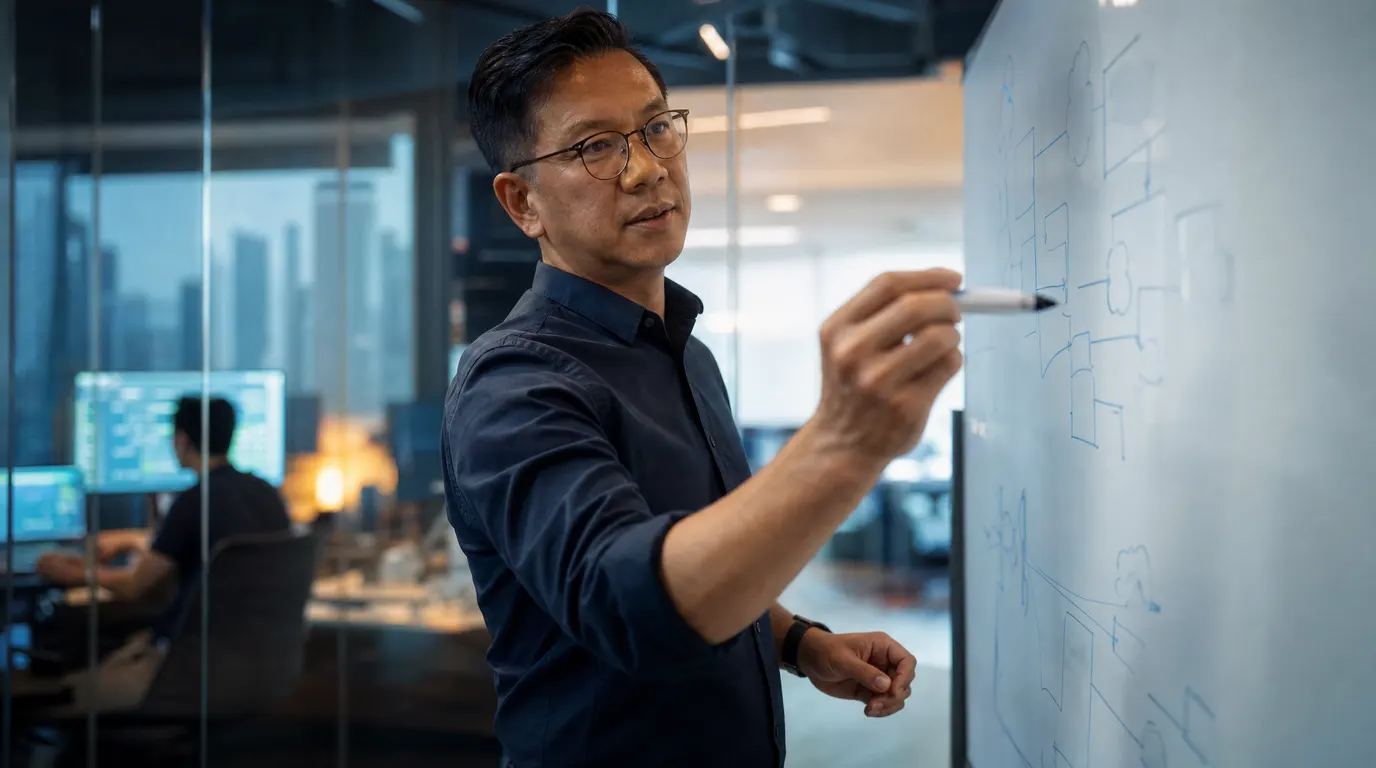 A senior software architect at a glass-walled Singapore office, sketching system diagrams on a whiteboard with faint code visible on screens behind, shallow depth of field, cinematic navy and warm light tones
The core shift: from code production to system design
To understand what changed, be precise about what AI coding assistants actually do. They predict the next token — calibrated on an enormous corpus of code. In practice, that makes them genuinely impressive at one class of tasks: producing syntactically correct, pattern-matching implementations of well-understood problems. Boilerplate, CRUD operations, unit test scaffolding, API client code, algorithmic patterns that appear often in training data — all of this handled at reasonable quality and astonishing speed.
What the model does not do is understand the why behind the system. It does not know that this microservice must be stateless because it will run across twelve nodes. It does not know that this authentication flow must satisfy MAS requirements on audit logging. It does not know that this data model, which looks sensible in isolation, will create a catastrophic join pattern at the query volumes expected in six months. The model knows code. It does not know context, constraints, or consequence.
This is the seam where the engineering role splits. Below it: code production, the mechanical translation of a well-specified problem into working syntax. AI is fast and competent here, and improving. Above it: the definition of the problem, architectural choices, constraint-setting, judgment about quality and risk, and ownership of what ships. AI is not equipped for this.
When code generation became cheap, the scarce thing became knowing what code to write, why, and what the system it lives inside must never do.
The economic logic matches every prior technology compression. When spreadsheets made arithmetic cheap, value moved from calculating to deciding what to calculate. When cloud computing made server provisioning cheap, value moved from racking hardware to designing the architecture that ran on it. Now that code generation is becoming cheap, the value moves from implementing a specified function to specifying the right function in the first place. The job moves up the abstraction stack, every time. Engineers who understand this and move with it get a more interesting, higher-leverage career. Engineers who define their professional identity by the quality of their hand-typed implementations face a harder road.
The global data, framed as reported and approximate, points at the churn underneath this. The World Economic Forum's Future of Jobs work has projected roughly 170 million new roles created and around 92 million displaced globally by 2030, with approximately 86 percent of employers expecting AI to transform their operations within that window. Within the technology sector specifically, the pattern is not wholesale displacement — it is acute task compression followed by role re-weighting toward higher abstraction. Speed without architecture produces technical debt at machine velocity. Teams that deploy AI tools without redesigning how architectural decisions get made will ship faster in the short term and slower in the long term, as machine-generated design choices — each locally sensible, none globally coordinated — create a system that is hard to reason about, harder to change, and expensive to secure. The human architect is not a bottleneck. The human architect is the force that keeps the machine's productivity from becoming the organisation's liability.
The Singapore read: talent, regulation, and the tripartite advantage
Singapore's specific context sharpens everything. This is a small, high-cost labour market with a technology sector that punches above its weight regionally, a government that has spent years funding engineering talent formation, and a regulatory environment — especially in financial services — placing serious demands on the quality and auditability of software running critical systems.
Start with the talent economics. Singapore engineers are expensive by regional standards. The business case for AI-assisted development is that you get more output from the same talent cost. But that case only materialises if you redesign the roles. It evaporates if you use the productivity gain as cover to cut headcount and then discover that the architectural judgment you let go was the thing keeping the system coherent. The engineering firms that win here over the next five years are not the ones that figured out how to need fewer engineers. They are the ones that deploy the same talented, expensive engineers on problems an order of magnitude more ambitious — using AI to handle the implementation surface so humans operate at the design and judgment surface. NICKTUNG's experience building custom systems for Singapore clients points consistently in the same direction: the constraint is almost never lines of code, it is design clarity and integration judgment — the things AI accelerates least.
Then consider regulation. MAS's FEAT principles — Fairness, Ethics, Accountability, Transparency — establish an expectation of explainability and human accountability in AI-influenced systems, particularly in financial services. Major Singapore banks — DBS, OCBC, UOB — operate inside this framework and their technology partners are expected to as well. This is not a market where you can deploy machine-generated code into critical systems without a human who understands and owns what the code does. The architect role is not optional overhead. It is the compliance requirement made concrete: someone must be accountable, someone must be able to explain the system, someone must trace a failure back through a design decision.
 A Singapore engineer pair-reviewing an architecture diagram on a large monitor, both leaning in, system boxes visible on screen, warm evening light through office glass, cinematic navy-charcoal tones
The tripartite system — government, employers, unions in deliberate coordination — is the third advantage Singapore has that most global commentary on engineering and AI completely ignores. Workforce Singapore's Career Conversion Programmes, NTUC e2i's job redesign support, and SkillsFuture's individual funding mechanisms exist to make role transitions managed conversions rather than abrupt culls. An engineer moving from execution-heavy coding into architecture, system design, or technical delivery leadership is exactly the kind of upward transition these programmes are built to support. The redesign can happen at scale and at speed in a way that would be far harder in a labour market without this scaffolding. NUS, NTU, and the polytechnics are already expanding curricula around systems thinking and applied AI engineering — shaping the pipeline for the world that exists, not the world of five years ago.
The playbook: four moves to redesign the engineering function
1. Decompose engineering roles into their actual tasks — then sort ruthlessly
Take each engineering role and decompose it into its actual tasks — not the job title, the tasks. For a mid-level software engineer: requirements clarification, system design, API design, database schema design, implementation of well-specified functions, code review, debugging, testing, documentation, deployment. Now sort each task: machine-cheap, human-machine collaboration, or pure human judgment?
Implementation of well-specified pattern-matching problems sits in the machine-cheap bucket — it is dishonest to pretend otherwise. But requirements clarification, system design, architectural trade-off decisions, and security threat modelling sit firmly in the human-judgment bucket and do not migrate. The task map tells you where the role is going before you make any headcount decision. It is not a threat to engineers. It is the tool that shows them where to invest their next five years.
2. Build the architectural guardrails the machine will work inside
AI-assisted development without architectural governance is the fastest known way to produce an unmanageable codebase. Before you scale AI tooling across an engineering team, establish the design system the machine will operate within. This means documented architectural decision records — the ADR discipline — so that choices about data models, service boundaries, API contracts, and security constraints are made deliberately by humans and then codified as constraints the AI-assisted work must respect.
The parallel with marketing is exact. A great editor working with AI on top of a strong brand system produces sharp output; the same editor with no brand system cleans up random noise. A great architect working with AI inside clear guardrails produces a coherent, maintainable system. An AI tool pointed at an engineering function with no architectural governance produces a technically impressive mess. In Singapore's regulated environment, the guardrails also encode audit logging, data residency, access controls, and failure modes — human decisions, documented, owned, and traceable. This is precisely where Freemansland's AI implementation work with clients focuses: not tool deployment, but the strategy, the guardrails, and the human-in-the-loop design that make machine-generated output safe and maintainable.
3. Redesign roles upward, then use the national scaffolding to fund the transition
With the task map in hand, rewrite the roles. The mid-level engineer spending 60 percent of their time on implementation tasks that AI now handles needs a redesigned role redirecting that freed capacity toward system design, technical leadership, and architectural review. This is a promotion in disguise, and it should be treated as one.
Workforce Singapore's Career Conversion Programmes can fund the employer's cost of moving an engineer from execution-heavy work into architecture and delivery leadership. SkillsFuture funds the individual's own investment in systems thinking, cloud architecture, and technical leadership. NTUC e2i supports the job redesign process itself. Use the scaffolding. As explored in how the rise of the AI orchestrator role is reshaping teams across Singapore, the pattern is consistent: the human moves up the stack, the machine fills the layer below, and the result is a more powerful team rather than a smaller one. The employer that redesigns and co-funds reskilling has a lower-cost transition and a more engaged team than the employer that cuts and rehires later when the architecture is drifting.
4. Measure the right things — and resist the headcount-saved trap
Headcount saved is not a win if the architectural layer degrades, technical debt balloons, or the team can no longer reason about its own systems. The right metrics: engineering output per person, code quality indicators (defect rate, security vulnerability density), and — most importantly — team capability to take on more ambitious problems. Is the engineering function building things it could not build before? Is the system coherent and auditable?
This is the same investor-facing logic that applies to the broader AI-driven organisational redesigns reshaping Fortune 500 firms with Singapore exposure. The discriminating signal is not cost reduction. It is whether the organisation can now do more and better — whether the redesign bought durable operating leverage or just a one-time saving with a future liability attached.
 A clean conceptual overhead view of an engineering team's project board, sticky notes and system sketches arranged around a central architecture diagram, charcoal and warm amber accent light, cinematic and abstract
The typist and the architect
Here is the useful summary for any engineering conversation in Singapore right now. AI coding assistants did not make engineers redundant. They made typing cheap. And in any market where a task gets cheap, the value migrates to whatever is still scarce — reliably and immediately, the thing the machine cannot do.
The machine cannot hold the system in its head and know when a locally sensible decision is globally dangerous. It cannot read a business requirement, understand the regulatory context, and decide that the right engineering response is to build almost nothing rather than something expensive. It cannot own the outcome when the system fails at 2 a.m. It cannot push back on a scope that would make the codebase unmaintainable. These are the things an architect does. They are also, now, the things that define an engineer's career trajectory.
For Singapore specifically, the stakes are clear. Firms that get the engineering redesign right — using AI to amplify architectural talent rather than as a reason to thin it — will build more capable, more defensible technology products at better unit economics. Firms that misread the moment, cut the engineers who hold the system together, and let AI-generated code accumulate without governance will spend the next few years paying down the debt in the most expensive way: slow teams, hard-to-diagnose failures, and compliance gaps in exactly the environments where Singapore regulators have the least tolerance.
The technology is settled. The choice is not. Redesign before you reduce. Move your engineers up the stack before you shrink the stack. The teams that internalise this will not merely survive the AI transition — they will use it to build things that were previously out of reach, with the same humans doing more ambitious work. That is what the moment is offering. It would be a shame to mistake it for a cost-cutting opportunity and nothing else.
Browse more in our Insights series on how Singapore's workforce is being redesigned — not reduced — by the AI transition.