

 Home
HomeThe revolution happening in operations and supply chain does not announce itself. There is no press release, no viral LinkedIn post, no C-suite keynote. What there is, quietly, on factory floors and in freight offices from Rotterdam to Jurong, is a wholesale rewriting of how physical goods move through the world — who decides what gets ordered, when it ships, how it is routed, and who signs off on the exception.
Operations is where AI meets the real economy. And yet it barely features in the public conversation about AI and work, which is dominated by knowledge workers and creatives. The logistics planner, the procurement analyst, the inventory controller, the warehouse team lead — they are doing the unglamorous, essential work that keeps shelves stocked and factories running, and AI is redesigning their jobs faster than the conversation has noticed.
This is the function-by-function read that operations deserves. Not a scare story, not a hype cycle. A clear-eyed account of which tasks are migrating, which are not, and what Singapore's businesses and people need to do — right now — to land on the right side of the shift.
The core shift: from human schedulers to AI orchestrators
Start with a simple question: what do operations and supply chain professionals actually do all day?
Strip away the org chart, and the answer is essentially the same across industries. They move information and decisions through a system — translating demand signals into purchase orders, translating inventory levels into reorder triggers, translating disruption signals into rerouting decisions. The physical goods move because someone, somewhere, processed a signal and made a call.
The crucial insight is this: most of those signals are structured, most of those calls are repeatable, and most of that information already lives in a database. A demand forecast is a weighted combination of historical sales data, seasonal patterns and macroeconomic indicators — exactly the shape of problem machine learning has been solving reliably for a decade. A purchase order is a rules-based reorder calculation. A freight routing decision is a constrained optimisation over cost, time and capacity — the kind of calculation a model can run across thousands of routes in the time it takes a human to open a spreadsheet.
The work of operations has always been, at its core, a massive information-processing exercise. AI did not change that. It just got dramatically better at processing information than any human team ever could.
This is why the scale of AI adoption in operations already dwarfs what most people imagine. Amazon's fulfilment network has been running AI-driven inventory placement and routing for years. Maersk uses AI for predictive maintenance and route optimisation. Walmart has deployed machine learning across its demand-forecasting and replenishment systems at a scale no human planning team could replicate. DHL has moved AI into parcel-sorting and last-mile routing. These are not pilots — they are production systems running at global scale, changing the composition of the work faster than the conversation about them.
What is changing is that machines can now handle operations end-to-end, across the full complexity of a real supply chain, in near-real time, at a cost that makes the economics of human-as-scheduler obsolete for the routine tier. The demand planner who spent 60 percent of their week pulling data and generating replenishment signals now has a machine doing that tier — and the question every operations leader faces is: what do we point the freed capacity at?
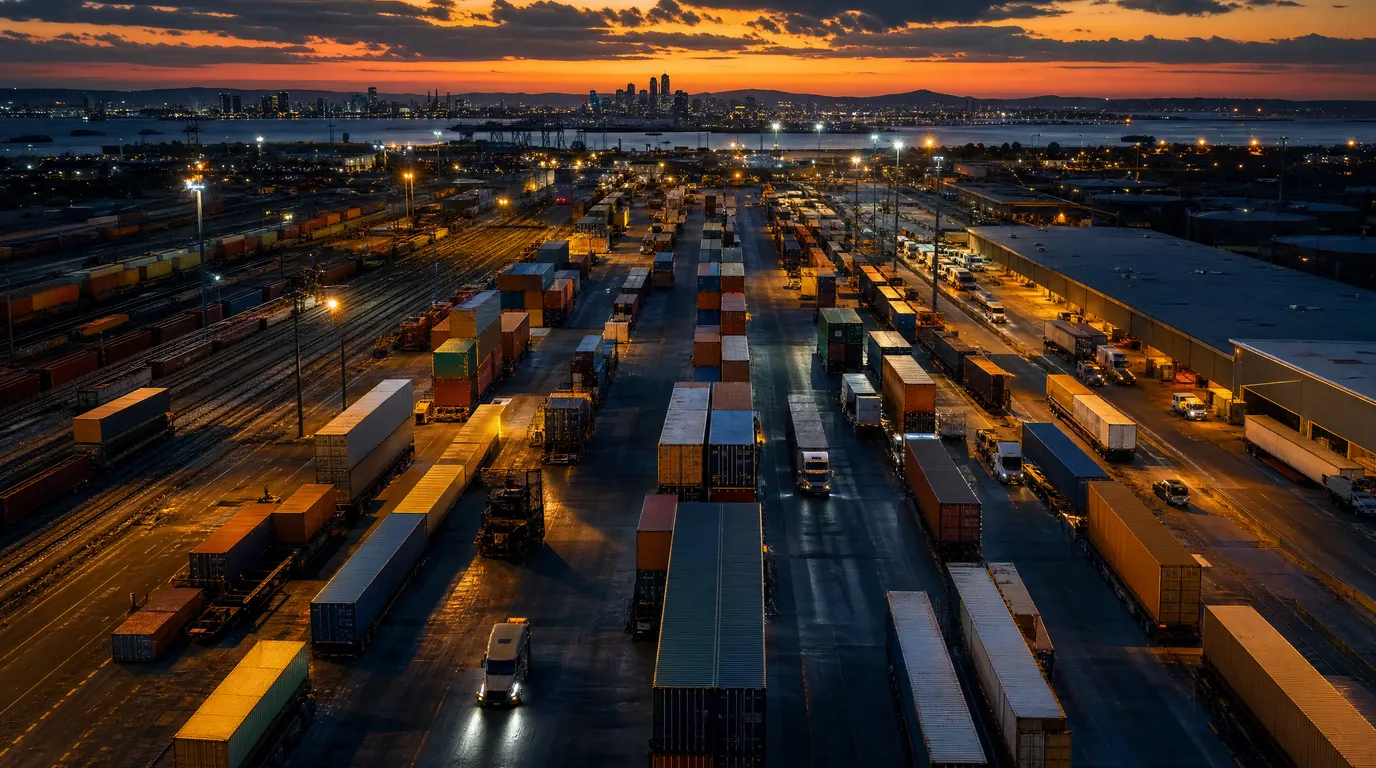 A cinematic aerial view of a modern logistics hub at dusk, shipping containers and freight vehicles arranged in geometric patterns, navy and amber tones, shallow depth of field
The answer, for the companies winning this shift, is not "nothing — so we can cut the team." It is the work the machine genuinely cannot do: supplier relationship management, disruption response that requires judgment about which commitment to break when everything goes wrong at once, ethical sourcing assessments that require reading a factory visit rather than a checklist, the negotiation call where a long-standing partner needs a human who understands the relationship. AI is absorbing the mechanical tier of operations with remarkable speed. It is barely touching the relational, the political and the genuinely novel.
The organisations that understand this redesign operations roles upward — turning demand planners into decision architects, procurement analysts into strategic relationship managers. The ones that do not are cutting the team, banking a short-term saving, and destroying the institutional knowledge no model can replace. The patterns playing out across Fortune 500 companies make this clear: the gap between organisations that redesign and those that merely reduce is widening fast, and operations is one of the clearest places to see it.
The Singapore read: a trade hub at the sharp edge
Singapore sits at an unusual vantage point in this shift, and the view from here is clarifying.
As a city-state built on being the most efficient, most trusted node in Southeast Asia's supply chains, Singapore has more at stake in getting AI-enabled operations right than almost any comparable economy. Port of Singapore is consistently ranked among the world's busiest container ports. The country's logistics, manufacturing and trading companies are the connective tissue of regional commerce. A disruption that a large economy absorbs with redundancy hits a trade-dependent hub hard and fast.
That exposure cuts both ways. Competitors who move faster on AI-driven freight, inventory and procurement will not merely be cheaper — they will be more resilient and better positioned to win contracts flowing through this hub. Being the most trusted node in Southeast Asian supply chains requires being, over time, the most capable node. In an era where AI is rewriting what "capable" means in logistics and procurement, standing still is a form of competitive decline.
But the upside is equally steep for businesses and people that move well. Singapore's operations workforce is dense and skilled, embedded in a national ecosystem actively managing this transition without the social fractures it has caused elsewhere. The WEF Future of Jobs 2025 report projects approximately 170 million new roles and roughly 92 million displaced globally by 2030 — a net positive in aggregate, but deeply disruptive in the specific. For operations workers in Singapore, the aggregate matters less than the local question: which tasks are migrating, which roles are growing, and what the path from the former to the latter looks like in practice.
The answer sits in Singapore's redesign infrastructure. Workforce Singapore and e2i run Career Conversion Programmes and Jobs Redesign grants specifically designed to move workers from a shrinking role into a growing one — with funding and structure behind the journey. SkillsFuture underwrites the reskilling itself, and the tripartite model — government, employers and unions working together — is the operating system for managing this transition without fracturing the social contract. The freed capacity from automating demand forecasting and purchase-order generation does not have to become a redundancy line. It can become a funded redesign of planners into supply-chain resilience specialists, of procurement analysts into strategic sourcing managers, of warehouse supervisors into AI-fleet coordinators.
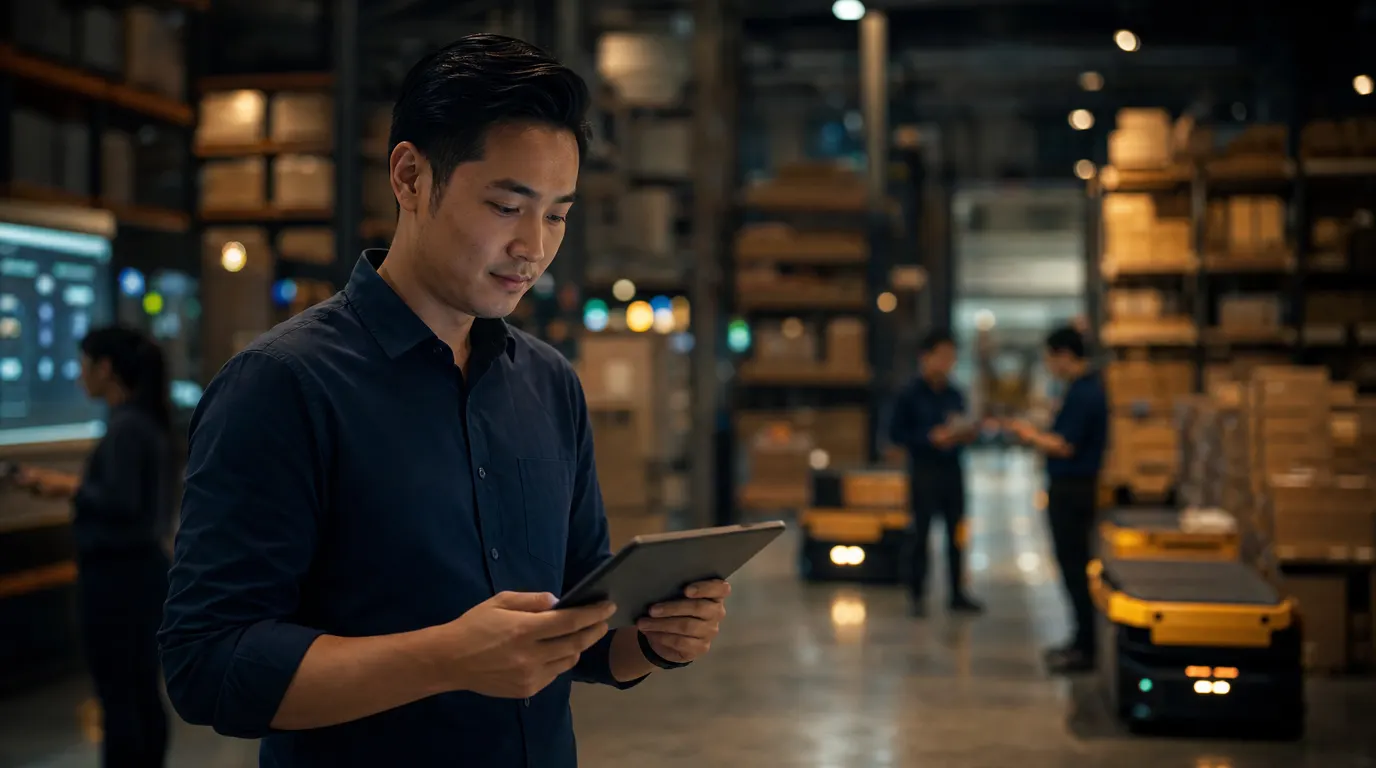 A Singapore warehouse where human workers and autonomous robots share the floor — warm amber lighting, cinematic depth, one worker in the foreground reviewing a tablet, machines blurred in the background
The financial services parallel is instructive. When MAS set its FEAT principles — Fairness, Ethics, Accountability, Transparency — for AI in finance, it effectively mandated human accountability on consequential decisions. Operations does not have FEAT, but it has the practical equivalent: when an AI-generated procurement decision embeds a forced-labour supplier, or an AI routing call contributes to a missed delivery that breaks a contract, a human is still legally and commercially accountable. That accountability creates a hard floor beneath which you cannot automate. For Singapore businesses competing for global supply-chain contracts, demonstrating that human judgment still governs the high-stakes calls is not a compliance posture — it is a trust asset.
The Microsoft 2026 Work Trend Index identified a "redesign gap" globally — productivity gains from AI outpacing organisational redesign. In Singapore operations teams, this gap is visible in a specific form: companies buying AI inventory and procurement tools and running them alongside the old manual processes because no one determined which process governs. The result is expensive duplication that produces neither machine efficiency nor human judgment quality. Closing it requires a deliberate, task-level audit of what the machine now does better, and an equally deliberate redesign of the human role around what it does not.
The playbook: four moves for operations leaders
Strategy without action is commentary. For an operations or supply chain leader in Singapore, the AI shift compresses into four concrete moves. Run them in this order.
1. Audit the task layer, not the headcount
Before you touch the org chart, map what your operations team actually does — task by task, not role by role. Pull a representative month of work across demand planning, procurement, inventory, freight and supplier management, and tag each activity: is it structured and repeatable, or does it require judgment, relationship or novel response?
You will almost always find that the structured, repeatable tier is a clear majority of the volume — and that it is consuming the time of people whose comparative advantage sits in the judgment tier. This audit is the foundation of everything that follows. Without it, you are cutting blind or automating randomly. Involve your team: operations staff know better than any consultant which parts of their day feel mechanical and which feel irreplaceable. Surface that knowledge formally. The audit produces the redesign map; the redesign map produces the programme.
2. Automate the structured tier — completely, not partially
Once the audit has identified the structured, rules-driven tasks, automate them without hedging. Half-measures are the worst outcome: they create a shadow process where humans do manual work alongside an AI system, satisfying neither efficiency nor quality. Demand forecasting, routine replenishment triggering, standard purchase order generation, freight rate comparison, invoice-to-PO reconciliation — these belong to the machine, fully, with the human reviewing exceptions rather than running the base case.
The critical implementation detail is the exception design. The machine runs the process; the human owns the exceptions — the supplier who flags a lead-time change, the demand signal outside the model's confidence interval, the disruption the training data never saw. Design the exception workflow before automating the base case, because it determines whether the human role is genuinely elevated or merely reduced to a queue of alerts with no real authority. NICKTUNG builds exactly these integrations — connecting AI forecasting and procurement tools to existing operations systems, with exception routing and human-decision capture built in from the start.
3. Redesign the role upward — in title, scope and pay
This is the step that separates the companies winning the shift from the ones that will spend two years fixing the damage of the cut.
When AI absorbs the structured tier, the remaining human work is not smaller — it is harder, higher-stakes and more valuable. The demand planner who no longer builds forecasts manually now governs the model's assumptions, interprets the outliers, and owns the supply-chain resilience strategy. The procurement analyst who no longer generates POs now manages the supplier relationships that protect margin when capacity tightens. The warehouse supervisor who no longer manually routes picks now coordinates the AI-directed fleet and handles the edge cases that break the algorithm.
Redesign those roles formally: new job descriptions, new metrics, new development paths. If you automate 60 percent of a role's tasks and leave the specification, pay grade and career path unchanged, you have created an under-specified employee managing nothing but exceptions and frustration. The redesign has to follow the automation. The ai-orchestrator role emerging across Singapore organisations is the template — a human who owns the AI system's outputs rather than competes with the AI system's inputs.
4. Reskill through the system Singapore built — and use the grants
For freed capacity that cannot immediately be redeployed into redesigned roles, use Singapore's reskilling infrastructure rather than releasing people. Career Conversion Programmes through Workforce Singapore and e2i exist precisely for this transition. SkillsFuture underwrites the reskilling. The tripartite model means government and unions are already invested in the transition's success — making redesign not just the ethical choice but the one with institutional tailwind.
The companies that will regret this moment are the ones that banked the one-time saving and spent three years regretting the knowledge that walked out the door. Institutional knowledge in operations — supplier relationships built over years, the informal understanding of which supplier always pads lead times, the judgement about which demand signals are noise — does not live in a database. It lives in the people who have been doing this work for a decade. A reskilling investment compounds that advantage; a redundancy payment sends it to a competitor.
The org design questions this transition raises — who governs the AI layer, how decision rights shift, what the new chain of command looks like — are real and cannot be answered by the technology alone. The sequencing matters: task audit first, then role redesign, then org design. Get the task layer right and the organisational questions become easier to answer.
 A wide-angle, cinematic shot of a lean Singapore operations team around a clean modern table, AI dashboards on large screens behind them, warm light, shallow depth of field, human faces attentive and engaged
The close: the quiet revolution will not wait
Operations and supply chain never generated the headlines that customer service or creative work did when AI arrived. The automation was gradual, and the people doing this work were not writing about it. But the revolution here is among the most consequential of all — because it is happening in the physical economy, in the systems that move goods, feed factories and keep prices stable. The gap between the companies redesigning well and the companies cutting blind is compounding faster than the public conversation has noticed.
The companies that will own Southeast Asia's supply chains in 2030 are building the capability now. They are auditing task layers, automating the structured tier completely, redesigning the human role upward, and reskilling through the infrastructure Singapore already built. They are using AI as an operating-leverage tool — one that lets the same skilled people govern far more complex, resilient supply chains than they ever could manually.
The thesis holds here as clearly as anywhere: AI does not replace people, it replaces tasks. The winners redesign the work. They do not just cut the team.
Freemansland works with Singapore businesses on exactly this redesign — from AI strategy and tool selection through to the implementation and change management that determines whether the investment becomes operating leverage or an expensive line in the software budget. The quiet revolution is already underway. The question is whether your operations team is redesigning to lead it or waiting to be caught by it.
For more on how AI is reshaping every function of the Singapore workforce, explore the rest of our Insights.